QTc Interval Calculator — Corrected QT (Bazett and Fridericia)
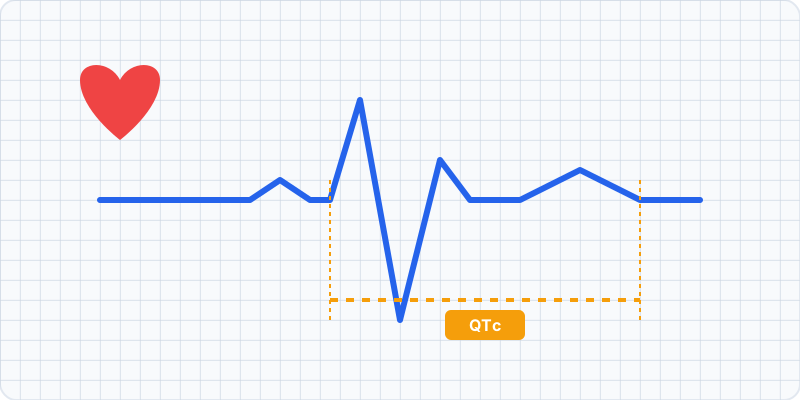
Calculate your corrected QT interval (QTc) instantly with this clinical-grade tool. Input your QT interval and heart rate to evaluate your risk of QT prolongation using the Bazett, Fridericia, Framingham, and Hodges formulas. This helps identify potential cardiac risks for both men and women accurately.
Table of Contents
QTc Interval Calculator
Disclaimer: This tool is for informational purposes only. Clinical decisions should be made by a qualified physician. Do not use this tool for self-diagnosis.
How to Use the Calculator
Using the QTc interval calculator requires just a few pieces of information from an electrocardiogram (ECG). I made this process straightforward.
First, enter the measured QT interval in milliseconds. You'll find this measurement on your ECG printout, measuring from the beginning of the QRS complex to the end of the T wave.
Second, input the rate. You can toggle between entering the Heart Rate (bpm) or the precise RR interval in milliseconds. Finally, select the patient's sex, as normal threshold values differ for men and women.
Hit calculate. The tool instantly runs the numbers across all four major clinical formulas simultaneously. It provides a clear interpretation based on standard medical guidelines.
QTc Correction Formulas
Because the QT interval naturally shortens as heart rate increases, we must calculate a "corrected" QT (QTc) to evaluate the true risk of repolarization abnormalities at a standardized rate of 60 bpm.
I included the four most validated formulas. Here is exactly how they work.
Bazett Formula
Bazett Formula
QTc = QT ÷ √(RR)
The Bazett formula is the oldest and most commonly used worldwide. However, I want to emphasize that it tends to overcorrect at fast heart rates (above 90 bpm) and undercorrect at slow heart rates.
Fridericia Formula
Fridericia Formula
QTc = QT ÷ ∛(RR)
Many modern cardiologists prefer Fridericia's cube root formula. It provides far more stable and accurate corrections at the extremes of heart rate compared to Bazett.
The Framingham formula (QTc = QT + 0.154 × (1 − RR)) and the Hodges formula (QTc = QT + 1.75 × (HR − 60)) are linear models that also perform better than Bazett at high heart rates.
| Interpretation | Men | Women |
|---|---|---|
| Normal | < 440 ms | < 450 ms |
| Borderline | 440 - 470 ms | 450 - 480 ms |
| Prolonged | > 470 ms | > 480 ms |
Worked Examples
Let's look at some real-world calculations to see how different formulas handle the same raw ECG data.
Example 1: Normal Heart Rate
A female patient has a QT interval of 410 ms and a heart rate of 65 bpm (RR = 0.923s).
Using Bazett: 410 ÷ √(0.923) = 427 ms (Normal).
Using Fridericia: 410 ÷ ∛(0.923) = 421 ms (Normal).
Example 2: Fast Heart Rate (Tachycardia)
A male patient has a QT interval of 340 ms and a heart rate of 110 bpm (RR = 0.545s).
Using Bazett: 340 ÷ √(0.545) = 460 ms (Borderline).
Using Fridericia: 340 ÷ ∛(0.545) = 416 ms (Normal).
Notice how Bazett overestimates the risk at high heart rates.
Example 3: Slow Heart Rate (Bradycardia)
A female patient has a QT interval of 490 ms and a heart rate of 45 bpm (RR = 1.333s).
Using Bazett: 490 ÷ √(1.333) = 424 ms (Normal).
Using Fridericia: 490 ÷ ∛(1.333) = 445 ms (Normal).
Tips for Accurate QTc Measurement
Getting a precise QTc interval starts with measuring the raw QT properly. A calculator is only as good as the numbers you feed it.
- Select the right lead: Always measure the QT interval in lead II or V5-V6, as these typically show the clearest T wave termination.
- Use the tangent method: To find the exact end of the T wave, draw a line down the steepest part of the descending T wave. Where it crosses the baseline is your end point.
- Exclude U waves: Do not include U waves in your QT measurement. Only measure to the end of the distinct T wave.
- Average multiple beats: Measure the QT across 3 to 5 consecutive cardiac cycles and take the average, especially if the patient has sinus arrhythmia.
- Double-check machine readings: Automated ECG machines frequently misread the end of the T wave. I always verify the computer's measurement manually.
- Switch formulas carefully: If the heart rate is outside the normal 60-90 bpm range, I strongly advise checking the Fridericia or Framingham numbers instead of blindly trusting Bazett.
Clinical Significance of QTc Prolongation
Understanding the clinical significance of a prolonged QTc interval is paramount for healthcare providers. The QTc interval represents the time taken for ventricular depolarization and repolarization, and its prolongation is a direct indicator of delayed ventricular repolarization. This delay is critically important because it creates an electrophysiological environment conducive to the development of early afterdepolarizations (EADs). These EADs can trigger a specific and highly dangerous type of polymorphic ventricular tachycardia known as Torsades de Pointes (TdP).
Torsades de Pointes is characterized by a distinctive electrocardiographic pattern where the QRS complexes appear to twist around the isoelectric axis. While TdP can be self-terminating, causing symptoms like palpitations, dizziness, or syncope (fainting), it frequently degenerates into ventricular fibrillation, leading to sudden cardiac death (SCD). Therefore, identifying patients with a prolonged QTc interval through accurate measurement and calculation using formulas like Bazett, Fridericia, Framingham, or Hodges is a crucial step in risk stratification and the prevention of sudden cardiac events.
Acquired vs. Congenital Long QT Syndrome
Long QT Syndrome (LQTS) can be broadly categorized into congenital and acquired forms. Congenital LQTS is caused by genetic mutations that affect the function of cardiac ion channels, most commonly the potassium or sodium channels. There are several different types of congenital LQTS, with LQT1, LQT2, and LQT3 being the most prevalent. Each type has specific triggers for arrhythmias; for example, LQT1 is often triggered by exercise or swimming, LQT2 by sudden auditory stimuli (like an alarm clock), and LQT3 typically occurs during sleep or rest.
Acquired LQTS, on the other hand, is much more common in general clinical practice. It is usually the result of extrinsic factors that interfere with the normal function of cardiac ion channels. The most frequent culprit is medication. Over 100 commonly prescribed drugs, including certain antibiotics (like macrolides and fluoroquinolones), antidepressants (like tricyclics and SSRIs), antipsychotics, antihistamines, and antiarrhythmics (such as amiodarone and sotalol), have the potential to prolong the QTc interval.
In addition to medications, electrolyte imbalances are major contributors to acquired QTc prolongation. Hypokalemia (low potassium), hypomagnesemia (low magnesium), and hypocalcemia (low calcium) can all delay ventricular repolarization. Other factors include structural heart disease, bradycardia, hypothyroidism, and central nervous system disorders. Frequently, a patient may have multiple risk factors simultaneously, such as taking a QTc-prolonging medication while also having an electrolyte deficiency, which compounds the risk exponentially.
Management Strategies for Prolonged QTc
When a patient is found to have a prolonged QTc interval, the management strategy depends on the underlying cause and the severity of the prolongation. For acquired LQTS, the immediate priority is to identify and withdraw any offending medications. Simultaneously, serum electrolytes should be checked, and any deficiencies, particularly in potassium and magnesium, must be aggressively corrected. Maintaining potassium levels in the upper normal range (around 4.5 to 5.0 mEq/L) and magnesium levels above 2.0 mg/dL is often recommended to stabilize the myocardium.
For patients with congenital LQTS, management is more complex and typically involves lifestyle modifications, such as avoiding competitive sports or specific triggers, and pharmacological therapy, usually with beta-blockers. Beta-blockers are the mainstay of treatment for most forms of congenital LQTS, as they blunt the sympathetic nervous system's response to stress, which is a common trigger for arrhythmias. In high-risk patients, such as those who have already experienced a cardiac arrest or who continue to have recurrent syncope despite beta-blocker therapy, the implantation of an implantable cardioverter-defibrillator (ICD) is indicated to provide life-saving shocks if a dangerous arrhythmia occurs.
In all cases, continuous monitoring and regular follow-up with a cardiologist or an electrophysiologist are essential. Electrocardiograms should be performed routinely to assess the QTc interval, especially when starting or changing the dosage of any medication known to affect ventricular repolarization.
Pediatric and Geriatric Considerations
It is also crucial to note that the normal ranges for the QTc interval can vary with age. In pediatric populations, the QTc interval may be slightly longer, and specialized pediatric criteria should be utilized for accurate diagnosis. Neonates and infants, in particular, require careful interpretation of their electrocardiograms, as their cardiovascular systems are still maturing. Conversely, in geriatric patients, the prevalence of acquired QTc prolongation is significantly higher due to polypharmacy and a greater incidence of underlying structural heart diseases, renal impairment, and hepatic dysfunction, which can alter the metabolism and clearance of QTc-prolonging drugs.
Therefore, healthcare providers must exercise heightened vigilance when prescribing new medications to elderly patients and should consider baseline and follow-up ECGs to monitor the QTc interval. Additionally, patient education plays a vital role. Patients should be informed about their condition and advised to seek immediate medical attention if they experience symptoms suggestive of an arrhythmia, such as unexplained fainting, severe dizziness, or a sensation of a racing or irregular heartbeat. Keeping a detailed and up-to-date medication list, including over-the-counter drugs and supplements, is also critical for safe healthcare management across all ages.
Frequently Asked Questions
What is a normal QTc interval?
A normal QTc interval is generally less than 440 milliseconds for men and less than 450 milliseconds for women. Values above 470 ms in men and 480 ms in women are considered prolonged and may require medical evaluation.
Why is the Bazett formula the most common for QTc?
The Bazett formula is historically the most widely used in clinical practice and by automated ECG machines. However, it tends to overcorrect at high heart rates and undercorrect at low heart rates.
When should I use the Fridericia formula instead?
The Fridericia formula is generally preferred when a patient has a resting heart rate over 90 bpm or under 60 bpm, as it provides a more accurate correction at extreme heart rates compared to Bazett.
What causes a prolonged QTc interval?
A prolonged QTc can be caused by genetic factors (Long QT Syndrome), electrolyte imbalances (such as low potassium or magnesium), and various medications, including certain antibiotics, antidepressants, and antiarrhythmics.
How do you calculate RR interval from heart rate?
To calculate the RR interval in seconds from a heart rate, divide 60 by the heart rate in beats per minute (bpm). For example, a heart rate of 60 bpm equals an RR interval of 1 second.




Cardiac health is part of a holistic wellness picture. Monitor your weight using our body mass index tool, set energy targets with our daily calorie calculator, balance your diet with our macronutrient planner, and address sleep-related cardiac risk with our sleep deficit calculator.
endurance athlete pace plannerPregnancy can affect QTc intervals. Our pregnancy timeline calculator helps track the trimester periods where cardiac monitoring is most critical.